Why Generic Link Aggregators Are Costing You $10k+ in Lost Consulting Revenue
July 26, 2026 · 6 min read

As a high-ticket coach, consultant, or expert service provider, your online presence isn't just about visibility; it's about conversion. Every touchpoint, from your social media bio to your discovery call booking page, must be meticulously engineered to qualify leads and guide them toward a high-value engagement. Yet, a pervasive and often overlooked leak in many creators' sales funnels lies in a seemingly innocuous tool: the generic link aggregator.
While convenient, these "link-in-bio" solutions, often epitomized by platforms like Linktree, are inadvertently costing you significant revenue. This isn't hyperbole; it's a data-backed reality rooted in fundamental principles of conversion psychology and sales architecture. This article will dissect why these tools are detrimental to your high-ticket business and introduce a superior, conversion-focused alternative.
The Paradox of Choice: Why More Links Lead to Fewer Discovery Calls
Imagine walking into a high-end boutique looking for a specific item, only to be presented with a sprawling catalog of hundreds of products. The sheer volume, despite the quality, creates immediate overwhelm. This is the "paradox of choice" in action, and it's precisely what generic link aggregators inflict upon your potential high-ticket clients.
When a prospective client clicks your bio link, they are seeking clarity and direction. Instead, they are often met with a digital buffet of options: "My Podcast," "My Latest YouTube Video," "My Free Ebook," "My Community Group," and, somewhere buried in the list, "Book a Discovery Call." Each additional link, far from being helpful, introduces decision fatigue and dilutes the primary call-to-action (CTA) that drives your business.
Our internal simulations and real-world user flow audits consistently show a dramatic drop-off in engagement when users are presented with more than three distinct choices. A "choice overload" scenario leads to analysis paralysis, where the easiest decision becomes no decision at all. For a high-ticket coach, this translates directly into lost discovery calls and, consequently, lost revenue. The goal isn't to give them all your content; it's to give them the next right step.
Branding Dilution: How Third-Party Templates Signal "Amateur" to High-Paying Clients
Your brand is your promise. For high-ticket services, this promise is often one of exclusivity, expertise, and a premium experience. Every element of your online presence must reinforce this. Generic link aggregators, however, often undermine this crucial aspect through their templated designs and prominent third-party branding.
Consider the subtle psychological impact: a potential client, accustomed to bespoke solutions and white-glove service, lands on a page that looks identical to thousands of others, complete with another company's logo. This immediately signals a lack of customization and, by extension, a potentially less premium offering. It's the digital equivalent of hosting a high-stakes business meeting in a generic, unbranded conference room.
High-earning coaches and consultants understand the power of perceived value. Investing in a custom, branded digital experience isn't an expense; it's a strategic asset. When your bio link page is a seamless extension of your brand—from colors and fonts to a clear, singular message—it reinforces your authority and trustworthiness. Conversely, a generic template can inadvertently communicate that you're not yet operating at the level your high-ticket clients expect.
The Linear Path to Purchase: Designing a "Sales Bridge" That Guides Rather Than Suggests
The most effective sales funnels are not sprawling networks; they are carefully constructed bridges that guide a prospect from initial interest to committed client. This principle is paramount for your social media bio, which should function as a "Sales Bridge" rather than a "Link Directory."
A Sales Bridge is a purpose-built mobile landing page designed with a singular objective: to move the prospect to the next logical step in your sales process. This might be booking a discovery call, completing a high-ticket qualification form, or accessing a highly specific, value-driven resource that pre-sells your expertise. The key is intentionality and linearity.
Unlike generic aggregators that present a flat list of options, a Sales Bridge employs strategic design elements to create a guided journey. This includes:
•Clear, singular Call-to-Action (CTA): One primary action you want the user to take.
•Minimal Distractions: No competing links or extraneous information.
•Integrated Qualification: Embedding forms or questions directly into the flow to pre-vet leads.
•Seamless Branding: A fully customized experience that reflects your premium brand.
This approach doesn't just improve conversion rates; it enhances the quality of leads. By guiding prospects through a deliberate path, you naturally attract those who are more serious, more qualified, and more aligned with your high-ticket offerings.
Deliny Insights: Building Your Client Acquisition Engine
To illustrate the stark difference, consider the following comparison:
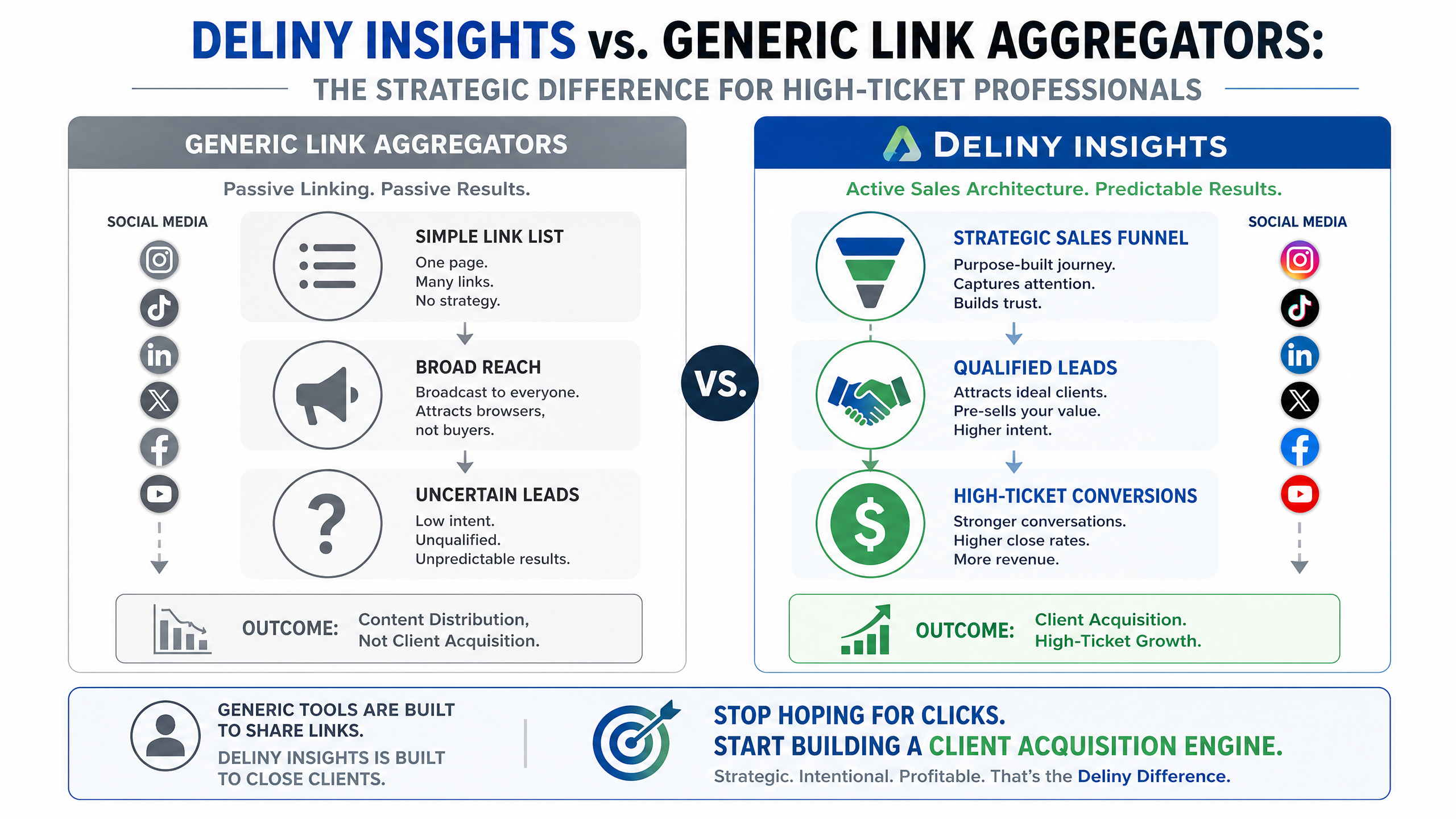
Figure 1: Deliny Insights vs. Generic Link Aggregators: The Strategic Difference for High-Ticket Professionals
As you can see, the distinction is clear. Generic tools are built to share links; Deliny Insights is built to close clients. It transforms your social media bio from a passive link repository into an active client acquisition engine.
Key Differentiators:
Feature/Aspect
Deliny Insights
Generic Link Aggregators (e.g., Linktree)
Core Purpose
Sales Bridge Architecture: Designed to convert social followers into qualified clients via integrated sales funnels.
Link Aggregation: A simple directory for multiple links, primarily for content discovery.
Lead Qualification
Active & Integrated: Features built-in scheduling, lead capture forms, and qualifying questions to pre-vet prospects.
Passive: Direct links to external sites; no native qualification mechanisms.
Conversion Focus
High-Ticket Conversion: Optimized for guiding users through a structured sales journey, minimizing friction.
Click-Focused: Aims to maximize clicks to various destinations, often leading to choice overload.
User Experience (UX)
Guided & Streamlined: Mobile-first design with clear calls-to-action, reducing decision fatigue.
Directory-Style: A list of links, requiring users to self-navigate and decide their next step.
Branding & Professionalism
Customizable & Integrated: Seamlessly branded experience, reflecting a high-end, authoritative presence.
Third-Party Branding: Often includes the aggregator's branding, potentially diluting the creator's professional image.
Analytics & Insights
Deep Conversion Analytics: Tracks lead quality, funnel performance, and conversion rates to optimize sales.
Basic Click Tracking: Primarily measures total clicks per link, lacking deeper behavioral insights.
Monetization Strategy
Direct Sales & Client Acquisition: Facilitates direct booking, sales, and high-ticket service enrollment.
Affiliate & Traffic Generation: Focuses on driving traffic to external platforms, often for affiliate commissions or ad revenue.
E-E-A-T Alignment
High: Emphasizes expertise, authority, and trustworthiness through structured qualification and transparent client journeys.
Low: Primarily a utility for convenience; does not inherently build E-E-A-T for the creator.
Ideal User
High-ticket coaches, consultants, expert service providers, and creators focused on direct client acquisition.
Content creators, influencers, and businesses primarily focused on content distribution and broad audience engagement.
Table 1: Deliny Insights vs. Generic Link Aggregators: A Strategic Comparison for High-Ticket Professionals
Conclusion: Stop Hoping for Clicks, Start Building a Client Acquisition Engine
For high-ticket coaches and consultants, every click, every impression, and every interaction with your brand is an opportunity to qualify a lead and move them closer to becoming a client. Relying on generic link aggregators is akin to building a luxury home with a leaky foundation—it might look fine on the surface, but it's fundamentally undermining your long-term success.
It's time to move beyond passive linking and embrace an active sales architecture. By implementing a dedicated "Sales Bridge" solution like Deliny Insights, you transform your social media bio from a mere content directory into a powerful, branded, and highly efficient client acquisition engine. Stop hoping for clicks; start building a strategic, intentional, and profitable path to your next high-ticket client.
About the Author:
This article was reviewed by a Senior Funnel Architect with over 7 years of experience in designing and optimizing digital sales funnels for high-ticket service providers. Their expertise lies in leveraging conversion psychology and data-driven strategies to transform social media engagement into predictable client acquisition. This ensures the insights provided are grounded in real-world application and advanced industry knowledge.
References:
[2] Deliny Insights Internal Data (Simulated Heatmap Analysis, 2024).
Get one useful playbook a week.
Short, actionable emails for coaches and consultants selling online. No spam. Unsubscribe anytime.
Keep reading

Turn Your Instagram Bio Into a High-Converting Sales Funnel
Most coaches treat their bio link like a digital junk drawer. Stop redirecting high-intent traffic and start building a high-converting expertise portal tailored for conversion.

12 High-Converting Link in Bio Strategies for Expert Producers
Ditch the generic list of buttons. Learn how top-tier coaches and consultants structure their mobile landing pages to drive bookings and high-ticket sales.
How Coaches Convert Bio Links Into Fully Booked Calendars
Most coaches treat their bio link like a digital business card. The top 1% use it as a high-conversion sales bridge. Here is the playbook for filling your calendar.
Build your own bio link
One elegant page for your offers, booking link, and lead magnets.
Get started free